Out of hospital birth increases the risk of death! Who could have seen that coming?

image

A new paper just published in The New England Journal shows — yet again — that homebirth in the US increases the risk of perinatal death. The paper is Planned Out-of-Hospital Birth and Birth Outcomes by Snowden et al.

I’m not surprised. I’ve been saying the same thing for nearly two decades.

[pullquote align=”right” color=”#000000″ ]Interventions are the price we pay to save babies’ lives.[/pullquote]

Let’s start with the take home message first:

Interventions are the price we pay to save babies’ lives.

It’s an inevitable trade off. Reducing interventions increases the number of babies who die. That’s not surprising because obstetrics is fundamentally preventive care. Obstetricians recommend interventions for the express purpose of preventing, diagnosing and managing complications. A woman who chooses to give birth outside the hospital is gambling that her baby won’t need lifesaving interventions. If she guesses wrong, her baby will die. It’s just that simple.

What specifically did the authors find?

They looked at nearly 80,000 “cephalic, singleton, term, nonanomalous deliveries in Oregon in 2012 and 2013.”

They did not look exclusively at home births or at homebirth midwives.

We compared planned hospital births with planned out-of-hospital births (an aggregate group of planned home births and planned birth-center births), including the out-of-hospital-to-hospital transfers.

In other words, they included birth center births and births attended by CNMs (certified nurse midwives) at home or at a birth center as well as homebirths and birth center births attended by CPMs (a second, poorly educated, poorly trained group of lay people who don’t meet international midwifery qualifications).

That’s important because it means that the study isn’t about homebirth but about all births outside the hospital.

What did they find?

Planned out-of-hospital birth was associated with a higher rate of perinatal death than was planned in-hospital birth (3.9 vs. 1.8 deaths per 1000 deliveries, P=0.003; odds ratio after adjustment for maternal characteristics and medical conditions, 2.43; 95% confidence interval [CI], 1.37 to 4.30; adjusted risk difference, 1.52 deaths per 1000 births; 95% CI, 0.51 to 2.54). The odds for neonatal seizure were higher and the odds for admission to a neonatal intensive care unit lower with planned out-of-hospital births than with planned in-hospital birth. Planned out-of-hospital birth was also strongly associated with unassisted vaginal delivery (93.8%, vs. 71.9% with planned in-hospital births; P<0.001) and with decreased odds for obstetrical procedures.

Planned out of hospital birth has a mortality rate 2.4X higher than hospital birth. The increased risk of death at homebirth is undoubtedly much higher. When Judith Rooks, CNM MPH looked at planned homebirth with licensed CPMs in Oregon in 2012, she found a death rate 9X higher than hospital birth.

The authors tell the NYTimes that they soft pedaled the findings:

Dr. Aaron Caughey, a co-author who heads the university’s obstetrics department, said the researchers consciously adopted a nonjudgmental tone so critics would not say that the in-hospital providers were demonizing out-of-hospital births.

Even Melissa Cheyney, CPM (who spent years presiding over Oregon homebirth midwifery and doing everything in her power to deny the increased risk of death) is quoted in the NYTimes article accepting the study’s results.

In truth, the findings are alarming. Although the authors tried to correct for the fact that the out of hospital group was whiter, wealthier and had fewer risk factors than the hospital group, they acknowledge that the hospital group was almost certainly a higher risk group. That means that the real difference in death rates is higher than 2.4X.

Most importantly, the increased risk of death reflects the lack of adequate regulation of out of hospital birth. In Canada and the Netherlands, midwives have the same perinatal death rates in the hospital or at home. If we want to lower the US out of hospital death rate, we need to adopt the same strict criteria for out of hospital birth that they use. We also need to abolish the CPM credential. Our midwifery standards should be in line with those of all other industrialized countries.

The authors of the study noted that the intervention rates outside the hospital were far lower than those in the hospital. The mainstream media appears to be emphasizing this point as well. Yet many if not most of the babies who died at home would NOT have died in the hospital. The central insight is this: interventions are the price we pay to save babies’ lives.

Could we lower intervention rates? Possibly. Could we safely lower them to the rates found at out of hospital birth? No, not unless we are willing to let babies die preventable deaths.

There’s also another critical take home message. American homebirth is and has always been less safe than hospital birth. Homebirth midwives have done everything in their power to hide the truth from American women. It’s not an accident than CPMs have no official safety standards. Safety has never been a priority for them, and the consequences have been — inevitably — dead babies who didn’t have to die.

Thinking about homebirth? Think again.

2015: This year in homebirth deaths and disasters

Homebirth reaper

As the end of the year approaches, it is time for the grim task of recapping the deaths and disasters from 2015. The toll of homebirth deaths and disasters, most presided over by homebirth midwives, is, above all, a shocking indictment of the second, inferior class of counterfeit American midwives known as CPMs (certified professional midwives).

The list is, unfortunately, longer than ever.

[pullquote align=”right” color=”#000000″]4 maternal deaths; 21 infant deaths; 9 babies who sustained brain damage.[/pullquote]

She trusted birth … and it killed her. Now her children will pay the price. (December 31, 2014).

Maria Zain, a prominent Malaysian-British advocate for unassisted homebirth, left 6 children motherless, including her newborn, after her 4th unassisted homebirth.

How to rationalize your baby’s near death at homebirth

Nacia Walsh’s story of the homebirth of her emaciated, compromised baby, How My Homebirth Saved My Daughter’s Life. Nacia is not merely ignoring the fact that her homebirth midwives nearly killed her baby, but is delusionally praising them for “saving” the baby. Be sure to check out the birth photo of the baby who looks like a 3rd world victim of starvation.

So many homebirth deaths I can barely keep track

A baby who died at homebirth in Florida 12 weeks ago, unexpectedly born dead.

A baby who died in Texas 6 weeks ago, unexpectedly born pulseless.

A baby who died in Phoenix last week whose mother, a doula, had a previous HBAC. I have not been able to establish whether the caregiver knew that the baby was dead before birth or was not expecting it.

A baby who died in October after his mother labored at The Farm and was transferred to the hospital for failure to progress. On arrival at the hospital, fetal distress was noted and the mother had an emergency C-section. It was too late. The baby could not be resuscitated.

A mother who died in December in Texas after postpartum transfer from homebirth. The baby was born lifeless but surived after cooling therapy to mitigate brain damage from lack of oxygen at birth. The mother died despite days of heroic efforts to save her life at the hospital.

Yet another mother dies at homebirth

Another Texas mother died at homebirth after suffering an amniotic fluid embolus. Would she have survived had she been in a hospital? That’s hard to say because amniotic fluid embolus has a 50% mortality rate. But we can be sure that she would have had a better chance at survival and the baby would have had a much better chance with an immediate C-section.

Update on one March homebirth death and report of a second death

A Connecticut mother played Russian Roulette and her baby lost. She attempted a VBAC at home. Her uterus ruptured and the baby died. The mother survived.

Homebirth death watch

Two separate homebirth deaths.

One took place in Michigan. It was the “standard” homebirth death: 42 weeks gestation, careless monitoring, followed by inability to locate the fetal heart rate, followed by the frantic trip to the hospital, followed by ultrasound confirmation of the death of the baby. The mother gave birth shortly thereafter, but the baby was already dead. Almost certainly this baby would be alive today if the mother had chosen hospital birth instead of a homebirth midwife.

The second death took place after a labor followed avidly in the a HBAC support administered by Meg Heket who runs the website Whole Woman, among others. The mother was attempting a UBA3C (unassisted homebirth after 3 C-sections). It’s not as though she didn’t understand that babies can die. She had already lost 1 infant to SIDS and had multiple miscarriages.

The mother labored on and off with ruptured membranes and a breech baby for five days. After noticing that she hadn’t felt the baby move in hours, she went to the hospital where they confirmed that the baby was dead.

Jill Duggar Dillard risks her baby’s life at homebirth

What kind of mother claims she “rocked” a birth that nearly killed her baby?

Ashley reported:

…I totally rocked by HBAC with my cesarean baby by my side and then about an hour later, my new love began having breathing issues. He has meconium aspiration syndrome and we have been admitted to the nicu. We are likely to be here for a week or more so he can fully recover…

I will share the birth story once we’re home again. It was so amazing and empowering!

In response, Selena explained:

This is what happened to me in Jan. My hbac went perfect, but little man had breathing issue because of meconium, so to the NICU we went for 5 days…

And Amanda chimed in with:

I had my second HBA2C in birth pool on March 24. He aspirated fluid when he was born and we spent his first 4 weeks in the NICU…

Another unassisted birth, another brain damaged baby

The mother reported:

I free birthed her but she got stuck in the birth canal. I birthed her head but could not get her shoulders out (she was 11lbs 9.5oz with linebacker shoulders). After 4-5 minutes I called paramedics who took about 2 minutes to get there. I got her out before they got there but she was unresponsive. They cut the cord immediately against my wishes. We should have killed that guy. Anyways, she was recovering under cooling therapy for 3 days to limit organ damage and has been recovering since…

Baby girl got her MRI yesterday. There appears to be no damage to her cerebrum (higher learning) but there is damage to her Thalamus/Basal Ganglia area (deeper brain that handles body functions like blood pressure, temperature control, libido, etc… She is not swallowing spit or choking … Smetimes I feel remorseful when the what ifs come but it could have happened anywhere.

Latest homebirth harvest of death

April 28:

A mother and her baby died after she collapsed during labor at a private clinic in Unity, Wisconsin. According to information on a community message board, she was transferred to the hospital where an emergency C-section was performed but it was too late to save either of them.

The community message board noted that there was a stillbirth at the same clinic in the previous week.

May 27.

Apparently this was an unassisted homebirth. The mother noted on Facebook:

He seems to be having shallow/grunty breaths … when should I be concerned? His little face is quite bruised so I can’t tell if he’s purplish looking because of that, or the breathing?

She took him to the hospital where he subsequently died due to brain damage and organ compromise.

June 14:

From a Facebook HBAC group:

Just wanted to post quickly in here that I got my HBAC!!!

We’ve been in the NICU due to our sweet son not breathing for some time after he came earth-side. Please keep us in your prayers.

According to subsequent posts, it appears that the baby sustained permanent brain damage.

Homebirth hell: 5, no 6, no 7 dead babies in one WEEK!

July 23 Baby Boy C.

Born in a CPM attended birth center. Birth announcement removed from the birth center’s page. Cause of death unknown.

July 24 Baby Boy C.

Died of massive hypoxic brain injury.

July 25/26 Baby Boy

Unassisted pregnancy, unassisted birth after a previous premature birth at 30 weeks. Baby died during labor.

July 26 Baby Girl E.

Attempted unassisted homebirth. Stalled at 9 cm. Mother’s friend crowd sourced advice on Facebook. Ultimately transferred to the hospital with a live baby. Baby appears to have died during further labor.

July 27/28 Baby gender unknown

Grand multip attempting HBAC. She had had multiple previous successful VBACs. Transferred for abruption. Mother developed eclampsia with seizures. No fetal heartbeat on admission to the hospital. Emergency repeat C-section for a baby that appeared to have been dead for at least an hour.

July 26 Baby Girl A

Born at home before noon after what appears to have been an HBAC. Baby immediately transferred to the hospital “due to complications of labor.” Baby died before midnight.

The 7th homebirth death on July 30 was the result of major congenital anomalies.

He’s a spastic quadriplegic as a result, but she’s glad she had a homebirth

Mother #1 writes:

Had this brave little chickie at home 6/1 … And didn’t go quite as planned. She was born unresponsive. No oxygen to her brain for unknown amount of time. Straight to the hospital (I was still naked in the ambulance!) then transferred an hour and half away where my fought [for] her life… Collapsed lung, spiration, heart problems, seizures, brain damage, low blood sugar … Just to name a few! Today she’s doing better than anyone said she would. She’s perfect… Currently only on feeding tube. And guess what… She was 9lbs, 90z and I didn’t tear!!!! And still, i’m glad I had her at home!

Mother #2 responds:

Congrats! We too had unexpected complications with one of our births, a severe placenta abruption. He suffered lack of oxygen for an extended period or time and was life flighted in where they cooled him for 5 days. He is now 2 1/2 and has severe spastic quad cp (cognitively unaffected) but we are so glad we had him at home too…

The cult of homebirth kills babies; 5 deaths in the last few weeks

Baby Girl Penelope. The mother was planning a UBA2C (unassisted birth after 2 C-sections). She went past 40 weeks (by her own estimation) and ruptured membranes at 43 weeks. At 44 weeks she noticed decreased fetal movement. At the hospital the baby was found to be dead.

Baby Girl Miranda Ruby. She died during an attempted UBAC. Her mother had a history of 3 previous successful VBACs. This time her uterus ruptured and her baby died.

A baby died in UC attempt in Winston NC. Seen in a local homebirth group. No further details are available at this time.

Baby Girl. Her mother runs a Facebook group called Rewilding Mama. She had no prenatal care. Water broke at 37 weeks on 8/30, and the baby was born 2 or 3 days later. She died the next day.

Baby boy. Mother was planning HBA3C. She was 42.2 and the perinatologist had recommended to delivery weeks before; she stopped going to appointments. She was being encouraged by a small VBA3C Facebook group. The mother noticed decreased movement and went in; the baby was dead and the mother opted for repeat C-section.

Maura and her no good, very bad, nearly deadly Bali homebirth

Without modern obstetrics, both Jessa and Jill Dugger would probably be dead

It all worked so perfectly … except for the part where the baby couldn’t breathe

The mother wrote:

Please keep my little daughter … in your thoughts and prayers. Two hours after an amazing homebirth this morning @42+1, my very bonnie 9.8 lb little girl suddenly developed breasthing problems and MW had to call an ambulance and we raced to the city hospital. She’s being well looked after in NICU (and looking like the most enormous baby surrounded by tiny prems), but we still don’t know what’s causing her very laboured breathing:-(

Followed by:

She’s doing OK, looks like she got fluid (may have been from her overly vigorous but slightly uncoordinated first breastfeed) on her lungs or possibly and infection. Just cuddled her and rocked her to sleep, and expressed her some colostrum…

Still in amazement that this lovely bonnie girl came out of my vagina! And I didn’t need stitches! It all worked so perfectly.

Nicola’s noxious narcissism: when the birth is more important than the baby

Nicola chose homebirth for her second baby because she wanted a “wonderful” birth. The birth was not wonderful for the baby, though.

But i was very unlucky, my baby was born not breathing 40 minutes away from hospital from which he has sustained serious brain injury and will live with serious life long disabilities.

Now I will spend the rest of my life wondering whether I should have gone against every instinct in my body and done as I was told by people I didn’t trust. If I had done that would my son have arrived safely??

Carmina also chose homebirth. According to the GoFundMe page:

T. was born on Wednesday, December 2, 2015 at home by mid wife. At some point during his birth two things went drastically wrong. He inhaled meconium which filled his lungs and the umbilical cord wrapped around his neck, cutting off his oxygen.

The midwife was able to rescusitate him after approximately 13 minutes, however, it is unknown how long T. had been cut off from oxygen intake, or at which point he inhaled the meconium. For the first 40 minutes of his life, he was not in Doctors’ hands as he was in route via helicopter to the Hospital.

He suffered severe brain damage.

*****

I no longer write about every homebirth death or disaster of which I learn. There are simply too many.

I wrote posts about:

4 maternal deaths

21 perinatal deaths

9 babies who sustained brain damage

Think homebirth is safe? So did the mothers in these 34 accounts.

Think homebirth is safe? Read the 34 stories and think again.
Breastfeeding prevents climate change? Really, Dr. Newman?

image

I wrote yesterday about the increasing desperation of lactivists in the wake of revelations that they have grossly exaggerated the benefits of breastfeeding in industrialized countries in order to support the breastfeeding industry. Dr. Melissa Bartick stooped to character assassination. Now, another major professional lactivist, Dr. Jack Newman, offers undoubtedly the most creative, albeit the most inane, exaggerations of the benefits of breastfeeding that I’ve yet seen.

Here’s what Dr. Newman had to say yesterday on his Facebook page:

[pullquote align=”right” color=”#3ABF4C”]How green is plastic used in breast pumps?[/pullquote]

One thing that is not often mentioned at all, never mind considered seriously, is the negative effect that formula feeding has on global warming. Breastfeeding can make a difference. Therefore, efforts to combat climate change should also focus on providing mothers real, effective, skillful help with breastfeeding.

Really, Dr. Newman? Really?

How does breastfeeding prevent climate change?

Let us look at how formula feeding affects climate change starting with the manufacture of infant formula. Making cow milk formula requires cows, cows that are huge emitters of methane, a gas that is made in the intestinal tract of ruminants. And methane is a carbon emission that increases global warming. But the problem does not stop there. Cows need to be fed, this means farming in order to grow food for them, including the production of fertilizers as well as transporting the feed. Milk produced in farms is taken to factories by vehicles that use gasoline…

So let’s see if I get this straight. The problem with formula is that cows need to be fed in order to produce it? But women don’t need to be fed to produce breastmilk? Wait a second, women need to be fed, too. And arguably, they need to be fed better quality food, including … you guessed it … meat from cows!

How green is the extra food (including meat) needed to create breastmilk? The calories have to come from somewhere. Is there any evidence that the production of breastmilk takes less farming, fertilizers and transportation of food than the production of cow’s milk?

But food isn’t the only thing used by women who are breastfeeding:

How green is the plastic used in breast pumps?
How green is the electricity used to run the pump?
How green are breast pads, nursing bras and lactation consultants (fuel needed to get to and from patients)?

Oops! I guess breastfeeding isn’t going to prevent climate change after all!

But for sheer inanity, it’s hard to beat Dr. Newman’s second, nonsensical claim:

…[B]reastfeeding actually is one of the most important methods of spacing out pregnancies, at least outside the developed world.

Really, Dr. Newman? Really??!!

I guess that’s why there’s no overpopulation, starvation, infanticide, unwanted pregnancies, or botched abortions in poor countries!

Oh, wait, those countries suffer from high overpopulation, starvation, infanticide, unwanted pregnancies, and maternal deaths from abortion. Breastfeeding is actually a remarkably poor way to space pregnancies.

But the truth doesn’t seem to matter to those desperately trying to manipulate women into using their breasts to feed their children.

Why does Dr. Newman have so little respect for the intelligence of American and Canadian women? Why does he have so little respect for women’s rights to control their own bodies?

The truth, as he ought to know, is that the benefits of breastfeeding in first world countries are trivial. Women have the right to decide for themselves if they want to use their breasts to feed their babies and they don’t need efforts to manipulate them with desperate, faulty and inane arguments like those advanced by Jack Newman.

Dr. Melissa Bartick owes Courtney Jung an apology

image

Well that didn’t take long.

Lactivists have faced the first real public challenge to their misrepresentation of the scientific evidence about breastfeeding, and they’ve already sunk to character assassination. I suppose that was only to be expected since they have no scientific evidence to dispute the central arguments in Courtney Jung’s book, Lactivism.

Not surprisingly, internist Melissa Bartick, MD is leading the charge. She committed the most egregious exaggeration of benefits and she’s been caught out. In her 2010 paper The Burden of Suboptimal Breastfeeding in the United States: A Pediatric Cost Analysis, using highly fanciful methods, Bartick “estimated” that the US could save 900 infant lives and $13 billion if 90% of US women breastfed. These numbers are grossly misleading since the purported savings are primarily the “lost wages” of the 900 dead infants (not a single one of which Bartick could identify then or now).

[pullquote align=”right” color=”#FD1221″]My baby, my body, my breasts, my choice![/pullquote]

Bartick became desperate relatively quickly; I guess that reflects the fact that there is absolutely no evidence to support her 2010 claims. She has promptly resorted to character assassination on the WBUR website:

If Donald Trump suddenly jumped into the breastfeeding fray, he might sound a bit like Courtney Jung.

I would have thought that such a gratuitous insult would be unworthy of both Bartick and WBUR, but I guess when you’re desperate the rules of civil behavior go right out the window.

At least Bartick is honest that her attempts to shoot the messenger are a response to having her work criticized:

I offer myself as Exhibit A in Jung’s book. She spends pages tearing apart a 2007 essay I wrote on combating formula proponents’ use of the word “choice.” Taking my essay out of context, she implies to readers that breastfeeding advocates do not think mothers should be given a choice in how they feed their infants. Here she describes me as an “ardent lactivist,” although in that very essay, I caution against “lactivism.” Jung couldn’t have gotten me more wrong: I have never engaged in any of the judgmental pressuring tactics to women I meet typical of the lactivists Jung describes.

Dr. Bartick, please don’t compound your harassment of new mothers by lying about it. Your words in Making the Case: Effective Language for Breastfeeding Advocacy make it clear that Jung described your views accurately.

You DON’T believe that mothers should be given a choice. Indeed you are so opposed to choice that you want the word eliminated from the discussion.

Choice” is the language of breastfeeding opponents. When they talk “choice,” it’s best to respond using entirely different language, like “marketing” or “profits.” Avoid the word “choice” altogether.

You DO believe in shaming women who don’t breastfeed, approvingly quoting Diane Weissinger’s ugly manifesto on shaming.

Instead of talking about the “benefits of breastfeeding,” talk about the risks of not breastfeeding.

You believe in IGNORING what women are saying about the breastfeeding experiences, as if your belief about their OWN experiences is more important than theirs:

Reframe “guilt” as anger or grief.

But the key issue remains exaggerating the benefits of breastfeeding:

Breastfeeding is a public health issue, just like smoking, safe sex, and seatbelts.

But it isn’t! Unlike the benefits of not smoking, safe sex, and seat belts, which can be measured in tens of thousands of lives saved every year, the benefits of breastfeeding in first world countries are trivial and even Bartick herself can’t identify any term babies in the US who died because of properly prepared formula, let alone the hundreds she claimed are dying each and every year.

When Bartick was asked in the comments why she didn’t retract her study since it is obviously untrue, she replied:

There is nothing to retract. The study was accurate at the time. And we are doing an update that includes maternal health and pediatric health. It is massive. This kind of research is painstaking and building the computer model and testing and retesting it has taken out[sic] team of 9 all this time. It is costly. And of course we say outright that the results assume the relationships are causal which might or might not be the case. However, given that mammals have evolved to feed their young their own milk over thousands of years, it would not seem that man can improve on this in a couple generations. Critics who do not engage in research such as Amy Tuteur, do not realize what needs to go into a well done study and what needs to happen to get it published. You can’t just make stuff up.

Whining that research is hard?

Invoking evolution?

It’s almost as bad as smearing Courtney Jung by associating her with Donald Trump.

Dr. Bartick owes Courtney Jung an apology, though I doubt that one will be forthcoming.

She also owes American women an apology for massively exaggerating the benefits of breastfeeding in an effort to force new mothers to breastfeed. In keeping with her own advice to other lactivists, Dr. Bartick insisted that formula feeding is a public health crisis, even though there is no scientific evidence to support that claim.

I can’t wait to see how Dr. Bartick attempts to smear me when my book, Push Back, is published in 14 weeks. I go beyond Jung’s argument that the benefits of breastfeeding have been exaggerated to promote the breastfeeding industry, and address the ways in which lactivism is profoundly sexist and deeply retrograde. Ultimately, the “breastfeeding wars” are about whether or not we believe women should be judged by the function of their reproductive organs.

That reflects a fundamental difference between Dr. Bartick and myself. She is so sure that women should have no choice but to breastfeed that she actually counsels other lactivists to refuse to discuss “choice” altogether. In contrast, I believe:

My baby, my body, my breasts, MY CHOICE!

The gift we can give other mothers for the holidays: support instead of shame

Female hands holding gift on wooden table.

There is a gift that we could give to each other each and every day, and the holiday season would be a great time to start.

What is that gift? Replace words of shaming with words of support.

[perfectpullquote align=”right” color=”#ADD8E6″]Let me watch the baby while you take some time for yourself.[/perfectpullquote]

I’ve thought a lot about the concept of shame, especially in relation to the package of mothering choices known as natural parenting. It seems to me that natural parenting has not done much for children, but it has done a lot of harm to women by making them feel ashamed. Mothers have always felt guilty of course, but shame is a relatively new emotion in relation to mothering.

According to the article For Shame: Feminism, Breastfeeding Advocacy, and Maternal Guilt published in the feminist philosophy journal Hypatia. Quoting a variety of mothers who feel like “failures” because they could not breastfeed successfully, the authors explain:

What these examples have in common is that they indicate something other than just guilt (though all of these women may, in fact, feel guilty). [They] all say they feel like failures. In all of these cases, the mothers’ emotions go beyond guilt, or the feeling that a particular action, or lack thereof, has broken a rule and caused harm. Rather, they judge themselves as deficient: bad mothers, failures. Such negative global self-assessments suggest what scholars have identified, in contrast to guilt, as shame, which “involves the distressed apprehension of oneself as a lesser creature” or “a painful, sudden awareness of the self as less good than hoped for and expected…”

We can give mothers an incredible gift by not shaming them in the first place. Here are a few examples:

1. Epidurals

Support: I’m so glad you got relief from the pain.

Shame: You wouldn’t take drugs the entire nine months of pregnancy; why did you take them in labor?

2. C-section

Support: I’m so glad that your baby is okay.

Shame: Your C-section was unnecessary. If you had been more educated about birth, you would have known that.

3. Breastfeeding

Support: Breastfeeding is difficult. You shouldn’t blame yourself. The important thing is that your baby is thriving.

Shame: There is no such thing as “not enough” milk. And if you were in pain when you were breastfeeding, you were doing it wrong.

4. The family bed

Support: The best sleeping arrangements differ for different families and even for different children within the same family.

Shame: What do you mean you need private time with your husband? Your baby is only young once; you’ll be married to your husband for decades.

5. Baby wearing.

Support: It’s great if a sling works for you, but the baby really doesn’t care as long as she is with you.

Shame: Your baby won’t feel loved if you don’t “wear” him. And without skin to skin contact, babies suffer from stunted emotional development.

6. The all consuming nature and isolation of caring for small children

There are lots of different way to shame women about this issue: Isn’t being with your baby more important than making money? I love my baby enough to do without material things.

Or, what do you mean you need time for yourself? There is nothing that you could be doing that is more satisfying than meeting your baby’s needs.

Or, I can’t believe you leave your baby with a sitter just so you can go to yoga class for an hour.

There are a lot of different ways to support for mothers who feel isolated and temporarily overwhelmed with parenting duties, but my personal favorite is this:

Bring the baby over to my house and I’ll watch him while you take a little time for yourself.


Adapted from a piece that first appeared in May 2012.

Why is Canadian homebirth safe but American homebirth dangerous?

Image converted using ifftoany

There’s yet another study out of Canada demonstrating the safety of homebirth for a subset of low risk women chosen by applying rigorous exclusion criteria. In contrast, every study of American homebirth, as well as state or national homebirth statistics that shows the US homebirth increases the risk of perinatal death.

Why is Canadian homebirth safe but American homebirth dangerous? The answer can be found in the paper, Outcomes associated with planned place of birth among women with low-risk pregnancies. Simply put Canadian midwives have far greater respect for the inherent dangers of childbirth than American homebirth midwives* (CPMs, LMs).

[pullquote align=”right” color=”#228149″]The Canadian system is predicated on the assumption that birth is untrustworthy.[/pullquote]

Let’s look first at what the researchers found:

Results: We compared 11 493 planned home births and 11 493 planned hospital births. The risk of our primary outcome did not differ signi cantly by planned place of birth (rela- tive risk [RR] 1.03, 95% con dence interval [CI] 0.68–1.55). These ndings held true for both nulliparous (RR 1.04, 95% CI 0.62–1.73) and multiparous women (RR 1.00, 95% CI 0.49–2.05). All intrapartum interventions were lower among planned home births.

Interpretation: Compared with planned hospital birth, planned home birth attended by midwives in a jurisdiction where home birth is well-integrated into the health care system was not associated with a difference in serious adverse neonatal outcomes but was associated with fewer intrapartum interventions.

The results reflect the many restrictions placed on homebirth in Canada.

1. Canadian midwives have far more education and training than American homebirth midwives. Canadian midwives must have a university level midwifery degree and extensive in hospital and out of hospital training. American homebirth midwives, in contrast, are really just lay people who awarded themselves a bogus credential that can be obtained with a period of unmonitored study and apprenticeship. American homebirth midwives have such ludicrously low standards that they had to “strengthen” them in September 2012 to mandate a high school diploma.

2. There are strict risk criteria for homebirth eligibility. Women with breech, twins, medical complications of pregnancy, pre-existing medical conditions and more than one previous C-section are not eligible for homebirth in Canada. Therefore, homebirth takes place within a well regulated medical system, not outside it and not in opposition to it.

3. Transfer rates are high. More than 45% of first time mothers were transferred to the hospital for an overall transfer rate of 24%. Transfer is undertaken if complications might occur. The threshold for transfer is remarkably low in contrast to American homebirth where the threshold for transfer is dangerously high, often not occurring until complications happen.

4. Homebirth is integrated into the medical system because Canadian midwives are integrated into (and regulated by) the medical system. American homebirth midwives are a second, substandard class of midwives that exist because they couldn’t or wouldn’t meet the standards of the medical system.

5. Childbirth is recognized as inherently dangerous. This is the key point. No one trusts birth; everything is predicated on the assumption that birth is untrustworthy. Safety is ensured NOT by managing complications at home, but by making sure that complications do not happen far from expert medical assistance of obstetricians and pediatricians. Nearly everyone who is at higher risk for complications is excluded a priori. Care during labor involves prompt transfer of anyone who might develop a complication. Strict education and training standards ensure that midwives have the experience to recognize impending complications instead of waiting for them to occur. Integration within the healthcare system means that there is no financial incentive for Canadian homebirth midwives to keep women at home as opposed to transferring them to the hospital.

What would we need to do if we wanted American homebirth to be as safe as Canadian homebirth? It’s pretty simple:

  • Abolish the CPM and restrict midwifery to people with university level midwifery degrees.
  • Enforce strict eligibility criteria for homebirth.
  • Exclude from homebirth anyone at increased risk of complications.
  • Transfer at the first sign of potential problems.
  • Require homebirth midwives to have hospital privileges.

Canadian midwives have shown that homebirth can be safe IF complications are expected and patients are transferred before complications occur. It has also demonstrated why American homebirth will NEVER be safe as long as we allow poorly educated, poorly trained lay people to award themselves counterfeit midwifery credentials and use those credentials prey on American mothers and babies.


*As distinguished from real American midwives (CNMs, certified nurse midwives).

The business of midwifery

Money stack with black blank space for text

Contemporary midwifery is to a distressingly large extent about wresting back economic control of childbirth from obstetricians. Midwives have woven a convenient fantasy about how obstetricians “stole” childbirth (and the money it represents) from midwives. That fantasy rests on a profound unwillingness to acknowledge both historical and scientific fact.

It is a historical fact that modern midwifery was made possible by modern obstetrics, which has ushered in an age in which childbirth seems safe. Previously doctors were called to childbirth in only the most dire circumstances. With the switch to routine hospitalization for birth and the routine presence of obstetricians, and, in particular the easy access to pain relief, midwifery went into decline.

[pullquote align=”right” color=””]Women came to prefer obstetrician care because of its safety and increased comfort.[/pullquote]

Don’t get me wrong; obstetricians were only too happy to supplant midwives, but that isn’t the proximate cause for the decline in midwifery. It is a historical fact is that women came to prefer obstetrician care because of its safety and increased comfort.

So midwives have fought back by deriding both the safety and the comfort of obstetrician led hospital birth. In addition, midwives took careful note of what obstetricians offer and offer the exact opposite. The tragedy is that in doing so, they are startlingly willing to sacrifice the safety of babies and the comfort of women.

The midwifery plan to wrest childbirth back from obstetricians is predicated on the following:

If obstetricians medicalized childbirth to make it safer, then midwives would de-medicalize it to make it more enjoyable, and, for added impact, would declare that childbirth was safe before obstetricians got involved.

If obstetricians offered screening tests and measures to prevent complications, then midwives would insist that “trusting birth” was all that was needed.

If obstetricians offered pain relief, midwives would proclaim that feeling the pain improved the experience, tested one’s mettle and made childbirth safer.

If obstetricians whisked babies off to pediatricians to make sure that they were healthy, midwives would claim that skin to skin contact between mother and infant in the first moments after birth was crucial to creating a lifelong bond.

If obstetricians insisted that modern obstetrics was based on science, midwives would accuse them of ignoring science, and if that didn’t stick, they’d insist that scientific evidence was not the only form of knowledge.

If obstetricians placed the highest value on a healthy mother and a healthy baby, midwives would place the highest value on a fulfilling birth experience.

In contemporary midwifery, every day is Opposite Day.

No matter what obstetricians offer, midwives insist that it is unnecessary, disempowering, harmful and contradicted by the scientific evidence. Or as feminist theorists. Ellen Annandale and Judith Clark, authors of the widely quoted paper, What is gender? Feminist theory and the sociology of human reproduction, describe contemporary midwifery:

…the largely unresearched antithesis of obstetrics. An alternative is called into existence in powerful and convincing terms, while at the same time its central precepts (such as ‘women controlled’, ‘natural birth’) are vaguely drawn and in practical terms carry little meaning.

The ultimate irony is that midwives are engaged in psychological projection. They are doing just what they accuse obstetricians of having done. Midwives are trying to wrest childbirth back from obstetricians and give it to those to whom they believed it rightly belongs … midwives themselves.

Kathy Dettwyler: formula-fed children definitely WILL BE INFERIOR

internet bullying

New motherhood is the last bastion of acceptable bullying and no one believes that more firmly than professional lactivists. Many are incensed by Courtney Jung’s book Lactivism, which shows definitively that the benefit of breastfeeding in industrialized countries has been dramatically overstated. In expressing their outrage they inadvertently demonstrate exactly the ugly, sanctimonious behavior that Jung decries.

Kathy Dettwyler, Associate Professor, Supplemental Faculty, Dept. of Anthropology, University of Delaware, Newark, is known for her cultural work on extended breastfeeding and weaning. What are her medical credentials? She has none, but that doesn’t stop her from pontificating on the benefits of breastmilk or bullying women for making feeding decisions of which she doesn’t approve.

[pullquote align=”right” cite=”” link=”” color=”” class=”” size=””]Were you breastfed or bottle fed, Prof. Dettwyler. I’d like to know which is responsible for your viciousness.[/pullquote]

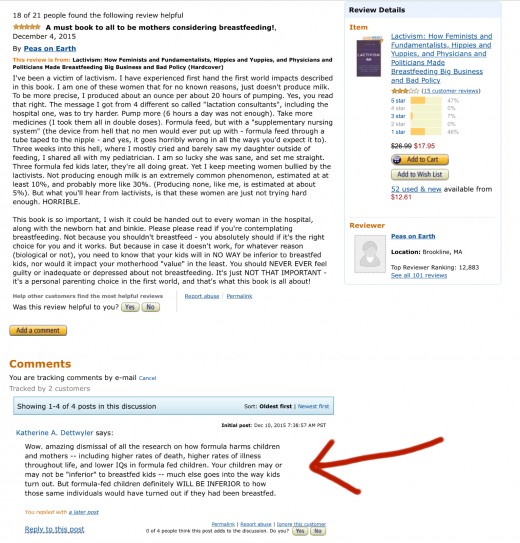
Responding to a heartfelt reader review of Lactivism on Amazon, Dettwlyer treats us to a glimpse of professional lactivism in all its malignant ugliness.

image

“Peas on Earth,” describes herself as a victim of lactivism. She is among the approximately 5% of women who CAN’T produce enough breastmilk to fully nourish an infant. She writes:

This book is so important, I wish it could be handed out to every woman in the hospital, along with the newborn hat and binkie. Please please read if you’re contemplating breastfeeding. Not because you shouldn’t breastfeed – you absolutely should if it’s the right choice for you and it works. But because in case it doesn’t work, for whatever reason (biological or not), you need to know that your kids will in NO WAY be inferior to breastfed kids, nor would it impact your motherhood “value” in the least. You should NEVER EVER feel guilty or inadequate or depressed about not breastfeeding. It’s just NOT THAT IMPORTANT – it’s a personal parenting choice in the first world, and that’s what this book is all about!

Who could disagree with that?

Kathy Dettwyler could and she publicly excoriates this poor woman:

… [F]ormula-fed children definitely WILL BE INFERIOR to how those same individuals would have turned out if they had been breastfed.

Really, Prof. Dettwyler?

Over the years I’ve read most of the major breastfeeding literature and I NEVER found even a single paper that demonstrated that formula fed children are inferior in any way to breastfed children. I’ve never read a paper from a reputable journal that even dared to advance that claim. Even those who invoke all sorts of unproven health benefits from breastfeeding haven’t thought to suggest that formula fed children are inferior. Even those who claim a tiny increase in IQ acknowledge out that this purported increase has no known impact in industrialized countries.

Here’s a thought, Prof. Dettwyler, how about taking a look at my Harvard yearbook and pointing out for us the formula fed graduates and explaining how much further they would have gone in life if only they had been breastfed? Wait, what? You can’t tell the difference between the formula fed and breastfed graduates? How can that be if formula leads to inferior human beings?

Or, better yet, how about making your ugly claims here on this blog and letting the physicians, scientists and statisticians who are regular readers school you on what the scientific literature actually shows instead of publicly berating a vulnerable mother on Amazon?

Wait, what? You don’t dare appear in any forum where others who know as much or more than you do could call you out for misrepresenting the scientific literature? You’re happy to publicly dish out viciousness but only in places where you can’t be held to account? Quelle surprise!

I’m sorry that Peas on Earth was subject to your viciousness, but I’m actually glad that you left your comment. You have illustrated the need for Jung’s book in a way that mere statistics never could.

I hope that you noticed my comment to you:

image

Were you breastfed of bottle fed, Ms. Dettwyler? I’d like to know which is responsible for your viciousness.

Lactivism and disciplining women’s bodies

image

With the possible exception of the author Courtney Jung, no one could be more thrilled about attention her book “Lactivism” is receiving than I am. The book has opened the door to the conversation that we need to have about the ways that natural parenting industries manipulate women into buying their products.

As everyone has undoubtedly heard by now, Lactivism rehearses the same arguments advanced by Joan Wolf in Is Breast Best? and Hanna Rosin in her Atlantic piece The Case Against Breast-feeding that the scientific evidence about the benefits of breastfeeding in industrialized countries is weak, conflicting and riddled with confounders. In fact, the only definitive benefits of breastfeeding are a few less colds and gastro-intestinal upsets across the population of infants in their first year.

[pullquote align=”right” color=”#F9B9D4″]Lactivism constricts the shape of mothering just as surely as the corset constricted the shape of women’s bodies.[/pullquote]

Lactivism has been reviewed by the NYTimes as a:

… riveting exposé of the forces that have turned the simple act of feeding one’s baby into a veritable battlefield, “to breast-feed or not to breast-feed” has become a question with far-reaching implications spanning medicine, politics, religion, feminism, commerce, race and social class.

Jung blames the lactation industry, including lactation consultants and breast pump manufacturers, for the moralization of breastfeeding. Indeed, as I have remarked in the past, the moralization of breastfeeding parallels the monetization of breastfeeding.

But there’s more going on here than merely an industry seeking profits. The unfortunate fact is that lactivism is just the New Age iteration of an age old tendency toward controlling women by disciplining their bodies. Lactivism, in conjunction with the philosophies of natural childbirth and attachment parenting, is the 21st Century equivalent of the corset. They constrict the shape of mothering just as surely as the corset constricts the shape of women’s bodies.

It is a sad fact of history that men have spent a tremendous amount of time policing women’s bodies. And an even sadder fact is that women have often been the prime enforcers in this effort. Natural childbirth was conjured by Grantly Dick-Read to convince white women of the “better” classes to drop efforts for political and economic equality and return home to have more children; La Leche League was created by a group of devout Catholic women who believed that mothers should not work outside the home and that convincing them to breastfeed was a way of keeping them there; and attachment parenting has been aggressively promoted by Bill and Martha Sears as “God’s plan” for ordering the family with the husband at its head and the wife as subservient.

The political, intellectual and economic emancipation of women that occurred in industrialized countries was one of the pivotal developments of the 20th Century. It brought with it tremendous social change, and tremendous social change rarely occurs without backlash. In my view, that backlash has been expressed on the political Right as the rise of religious fundamentalism that automatically relegates women to the home. It’s been expressed on the political Left as the rise of natural parenting (natural childbirth, lactivism, attachment parenting) that, though ostensibly about children and how they are raised, is really about women and what they are supposed to sacrifice when they have them. Lactivism, in company with natural childbirth and attachment parenting, renders women’s needs invisible, and when practiced with full adherence to its principles renders women invisible in the public sphere.

Jung is absolutely correct that lactivists grossly exaggerate the benefits of breastfeeding, and she is also correct that the moralization of breastfeeding has been promoted by the lactivism industry. In so doing, she has started a national conversation about whether a big business has promoted bad policy (it has!). But, in my judgment, that is just the beginning of the conversation we need to have. The real issue at stake is NOT how infants are fed; the real issue is how mothers of infants are supposed to behave in order to qualify for the designation “good mother.”

There is nothing wrong with breastfeeding or unmedicated childbirth or attachment parenting if those are the choices that work best for individual women and their families; I chose to do all of them with my own children. But there is something very wrong with philosophical movements devoted to forcing those choices on other women, essentially disciplining their bodies for every moment of the 9 months of pregnancy, the hours of labor and childbirth, and the years of parenting beyond.

It constricts the shape of mothering and while it may be big business, it is bad for women.

Dr. Amy