C-sections, asthma and white hat bias

image11-e1450204599907

The study of C-sections is afflicted with white hat bias.

What is white hat bias?

‘White hat bias’ [is] bias leading to distortion of information in the service of what may be perceived to be righteous ends… WHB bias may be conjectured to be fuelled by feelings of righteous zeal, indignation toward certain aspects of industry, or other factors. Readers should beware of WHB and … should seek methods to minimize it.

I’ve written about white hat bias before in relation to breastfeeding. In 2015 everyone “knows” that breast is best. Breastfeeding researchers are so sure that breastfeeding is beneficial that they exaggerate findings that place breastfeeding in a positive light.

[pullquote align=”right” color=””]It seems irresponsible to draw any conclusions from this data.[/pullquote]

Similarly, in 2015, everyone “knows” that the C-section rate is too high. Researchers are so sure that C-sections are harmful that they exaggerate findings that place C-sections in a negative light. A new paper about C-sections and asthma is a case in point.

According to yesterday’s New York Times:

For years, research has shown that babies born by cesarean section are more likely to develop health problems. Now, a groundbreaking study suggests that not all C-sections are equally risky…

Surprisingly, the data seemed to show more health problems among babies born by planned C-section than among those delivered by emergency C-section or vaginal birth, even though the planned surgery is done under more controlled conditions. The finding suggests that the arduous experience of labor — that exhausting, sweaty, utterly unpredictable yet often strangely exhilarating process — may give children a healthy start, even when it’s interrupted by a surgical birth.

Actually, the data on health problems caused by C-sections is weak and conflicting and this new study is more of the same.

The paper is Planned Cesarean Delivery at Term and Adverse Outcomes in Childhood Health by Akinbami et al. According to the authors:

Among offspring of women with first births in Scotland between 1993 and 2007, planned cesarean delivery compared with vaginal delivery (but not compared with unscheduled cesarean delivery) was associated with a small absolute increased risk of asthma requiring hospital admission, salbutamol inhaler prescription at age 5 years, and all-cause death by age 21 years. Further investigation is needed to understand whether the observed associations are causal.

What exactly did they find?

Compared with offspring born by unscheduled cesarean delivery (n = 56 015 [17.4%]), those born by planned cesarean delivery (12 355 [3.8%]) were at no significantly different risk of asthma requiring hospital admission, salbutamol inhaler prescription at age 5 years, obesity at age 5 years, inflammatory bowel disease, cancer, or death but were at increased risk of type 1 diabetes (0.66% vs 0.44%; difference, 0.22% [95% CI, 0.13%-0.31%]; adjusted hazard ratio [HR], 1.35 [95% CI, 1.05-1.75]). In comparison with children born vaginally (n = 252 917 [78.7%]), offspring born by planned cesarean delivery were at increased risk of asthma requiring hospital admission (3.73% vs 3.41%; difference, 0.32% [95% CI, 0.21%-0.42%]; adjusted HR, 1.22 [95% CI, 1.11-1.34]), salbutamol inhaler prescription at age 5 years (10.34% vs 9.62%; difference, 0.72% [95% CI, 0.36%-1.07%]; adjusted HR, 1.13 [95% CI, 1.01-1.26]), and death (0.40% vs 0.32%; difference, 0.08% [95% CI, 0.02%-1.00%]; adjusted HR, 1.41 [95% CI, 1.05-1.90]), whereas there were no significant differences in risk of obesity at age 5 years, inflammatory bowel disease, type 1 diabetes, or cancer.

Children born by planned C-section were at slightly increased risk of asthma requiring hospital admission, slightly increased risk of needing asthma medication at age 5 and increased risk of death both before age 1 and from 1-21. There were no significant differences in rates of obesity, inflammatory bowel disease, type I diabetes or cancer.

image

Comparing the effects of planned C-section to unplanned C-section revealed no difference in rates of asthma requiring hospital admission, need for asthma medication at age 5, obesity, inflammatory bowel disease, cancer or death, but an increased risk of type 1 diabetes.

Akinbami table 2

So C-section appeared to slightly increase the risk of asthma (an auto-immune disease), but no other auto-immune diseases, and to increase the risk of unexplained death.

The authors also performed a sensitivity analysis. What is a sensitivity analysis?

The credibility or interpretation of the results of clinical trials relies on the validity of the methods of analysis or models used and their corresponding assumptions…

A sensitivity analysis addresses the validity of the assumptions used in calculating the results.

If, after performing sensitivity analyses the findings are consistent with those from the primary analysis and would lead to similar conclusions about treatment effect, the researcher is reassured that the underlying factor(s) had little or no influence or impact on the primary conclusions. In this situation, the results or the conclusions are said to be “robust”.

What was the result of the sensitivity analysis in this paper:

Complete case analyses comparing outcomes following planned cesarean delivery with unscheduled cesarean delivery demonstrated no significant differences in risk of any outcomes studied, as reported in Table 4. Complete-cases analysis revealed a significantly increased risk of offspring obesity at age 5 years following planned cesarean delivery compared with vaginal birth, but no significant differences in risk of salbutamol inhaler prescription at age 5 years, asthma requiring hospital admission, inflammatory bowel disease, cancer, or death up to age 21 years.

So, if I understand the sensitivity analysis correctly, it produced different results from the primary analysis, which means that the findings are NOT robust.

Nonetheless, the authors conclude:

Among offspring of women with first births in Scotland between 1993 and 2007, planned cesarean delivery compared with vaginal delivery (but not compared with unscheduled cesarean delivery) was associated with a small absolute increased risk of asthma requiring hospital admission, salbutamol inhaler prescription at age 5 years, and all-cause death by age 21 years. Further investigation is needed to understand whether the observed associations are causal.

It would have been more accurate to say that WEAK DATA showed a small absolute increase in the risk of asthma and unexplained death.

In other words, it seems rather irresponsible to draw any conclusions from this data. That didn’t stop the authors, though. They “know” that C-sections are bad and white hat bias led them to search until they found some weak data that seemed to support that pre-existing belief.

It’s yet another poor contribution to the confusing and conflicting papers that claim to show the “harms” of C-section, but, in truth, don’t show anything at all.
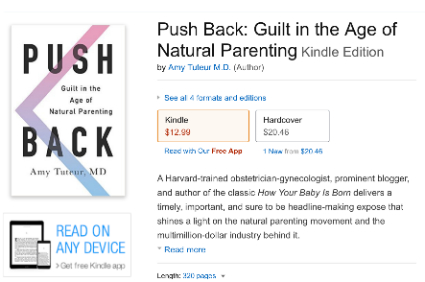

An excerpt from Push Back: Guilt in the Age of Natural Parenting

image

Last night I sent in the final edits for my forthcoming book Push Back: Guilt in the Age of Natural Parenting. I’m posting an excerpt in celebration. The book will be published by HarperCollins on April 5, 2016.

When I was a practicing obstetrician, I spent a lot of time correcting the misinformation of natural childbirth advocacy, and comforting women who had had healthy babies but still felt guilty for not “achieving” a vaginal birth or a birth without pain relief. Though I was aware of the emotional response from my bedside visits, it took years of blogging about the subject, corresponding with mothers, and arguing with activists to appreciate the true depth, breadth, and prevalence of misinformation coming from the natural parenting movement, and how this has come to blight the experience of mothering infants for so many.

Twenty years ago, when I began writing on the web, I thought that the problem could be solved with more and better information. Most of what passes for knowledge within natural childbirth, lactivist and natural parenting communities is flat out false. Yet simply correcting that myriad of falsehoods seemed to be fruitless. I came to understand that natural childbirth, lactivism and attachment parenting actually is about privileging the process over the outcome.

Natural childbirth, lactivism and attachment parenting are highly stylized, profoundly idealized representations of parenting. How do we know that they are idealized? Primarily it’s because the scientific evidence does not support most of their central tenets. That’s not to say that natural parenting advocates don’t believe in science; they do and they invoke science a lot. However, a close examination reveals that they often subvert the scientific evidence to arrive at predetermined conclusions.

Why would anyone want to subvert the scientific evidence on childbirth, breastfeeding and attachment parenting? Because each of these ideas have morphed into businesses, complete with trade unions, lobbying groups and brilliant marketing. Simply put, misinformation is being promoted by birth and breastfeeding professionals, as well as parenting gurus, as a way to make money. These factions portray doctors as the enemy, and their primary product has become distrust of the medical profession. They created alternate worlds of internal legitimacy in the same way that creationists and anti-vaccine activists had done before them, complete with books, journals, conferences and certifications to signify “expertise.” The internet has been their greatest enabler, allowing women to “research” parenting decisions without ever leaving a massive echo chamber.

There’s far more than money at stake. Beliefs about women and their role in society undergird natural parenting. It seems to me to be more than coincidence that natural childbirth, breastfeeding and natural parenting share a variety of disturbing characteristics: all imposed an inordinate amount of work and pain on women, and all ostensibly exclude fathers and other family members, making women not merely the primary caregivers but the only acceptable caregivers a majority of the time. And by requiring intense, round the clock effort, it makes it nearly impossible for women who want or need something in addition to mothering (a job, a career, free time) to be “good” mothers. It all seems suspiciously like the classic ploy to control and judge women by the performance of their reproductive organs.

When I dove deeper, I was not surprised to find that most of these movements were created or promulgated by elderly white men. Advocates represent natural childbirth, lactivism, and attachment parenting as the ultimate expressions of parental love, combining scientific evidence with maternal devotion, feminism and respect for maternal choice. The reality is far different. It is an interesting question how these philosophies that gather under the rubric of natural parenting put forward a pro-woman agenda but in fact are quite the opposite. In this book, I will show the evolution of each of the aspects of natural parenting—natural childbirth, lactivism and attachment parenting, from their origins to the big business they are today, from a search for authentic experiences to a prescribed experience that relegates women back into old-fashioned roles prescribed by gender.

Push Back tackles the natural parenting industry from all sides, hopefully alleviating guilt so many women unnecessarily face, revealing it to readers as the damaging, sometimes dangerous construct I think it is.

Midwives oppose the use of drugs in labor … unless they can administer them

image

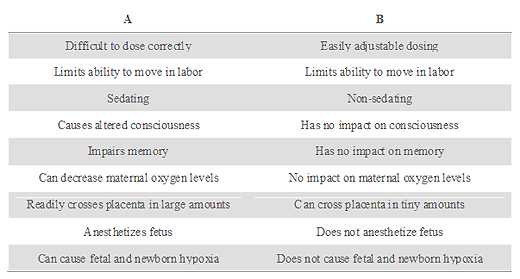
Below are the characteristics of two types of pain relief in labor. Guess which one is favored by midwives.

image

If you guessed “B,” you’d be wrong.

True, it is easily adjustable, non sedating, has no impact on memory or oxygen levels and crosses the placenta in miniscule amounts if at all. But it’s the dreaded epidural and it’s bad, bad, bad.

[pullquote align=”right” color=”#F87DD5″]All the pious wailing about the effects of epidurals are nothing more than hypocrisy. [/pullquote]

“A” is, in fact, favored by midwives and used extensively by midwives around the world at home and in the hospital. Indeed, many midwives believe it is perfectly compatible with natural childbirth despite the fact that it is most certainly a drug, marketed by a pharmaceutical company, is difficult to dose effectively, causes sedation and impaired memory, and readily crosses the placenta in large amounts where it sedates the baby.

Shocked? You shouldn’t be. Drug “A” is nitrous oxide and American midwives are clamoring for its use.

A new patient handout prepared by the Journal of Midwifery and Women’s Health expounds on the virtues of nitrous.

… Many women in Europe and other countries, such as Canada and Australia, use it to help cope with pain in labor. It is so common that in some countries as many as 8 in 10 women use nitrous oxide to help with labor pain. Women in these countries have been using this method of pain relief in labor safely for many years. Nitrous oxide hasn’t been used as often in the United States, but that is changing.

The handout acknowledges that nitrous produces altered consciousness and distorted memory, but apparently does not consider that a problem. The handout glosses over the impact of nitrous on the baby:

Nitrous oxide is the only pain relief method used for labor that is cleared from your body through your lungs. As soon as you pull the mask away, the effect of breathing the gas is gone within a few breaths. No extra monitoring is needed for you or the baby because you are using nitrous oxide. If you did get too sleepy, a monitor to check your oxygen levels might be placed on your finger. Nitrous oxide is safe for your baby, so if your baby’s heart rate is being checked intermittently (off and on) rather than continuously (all the time) with a fetal monitor, that is still okay…

Midwives are apparently unconcerned that nitrous crosses the placenta easily and in large amounts, producing sedation and altered consciousness in the baby. In fact, it would be quite accurate to state that nitrous “drugs” the baby whereas epidurals do not.

What’s the impact of nitrous on breastfeeding and newborn behavior? That’s not clear because very little research has been undertaken on the impact of nitrous on the newborn.

So by every parameter we can measure, nitrous has far more impact on women and babies than an epidural, yet nitrous is “good” and epidurals are “bad.” What accounts for this paradox?

It’s simple: midwives can administer nitrous, but lack the skills and training to administer epidurals.

All the pious wailing about the effects of epidurals are nothing more than hypocrisy. It really makes no difference to midwives whether women use “drugs” in labor to relieve pain, even if those drugs limit ability to move in labor, alter consciousness, impair memory, decrease oxygen levels, readily cross the placenta and sedate the fetus … just so long as they can administer the drugs.


This piece first appeared in December 2013.

UK trying to push women into homebirths that they don’t want

image

For many years, UK midwives and natural childbirth advocates insisted that a significant portion of women would choose homebirth if it were available to them. That hasn’t turned out to be the case. Despite increased promotion of and access to homebirth, despite research tailor made to promote the “safety” of homebirth, the UK homebirth rate has not increased very much at all.

But UK homebirth advocates haven’t given up. Their latest effort to force women into homebirths that they don’t want comes courtesy of NICE, the National Institute for Health and Clinical Excellence, who have decreed that pregnant women must be informed of interventions rates in all hospitals.

[pullquote align=”right” color=””]The promotion of homebirth rests on the belief that women’s agonizing pain in labor can be ignored.[/pullquote]

An article in The Daily Mail lays out the “problem”:

Statistically, home births or those in a small midwife-led unit are just as safe as hospital deliveries for women at low-risk of complications.

But most still choose to go to hospital, where doctors are immediately on-hand in case anything suddenly goes wrong.

Imagine that! Women want to give birth at the place best equipped to handle life threatening emergencies. We must discourage them from putting safety first!

The purported “solution”?

Guidance from NICE states that GPs or midwives should provide expectant mothers with information about the safety and risks of complication ‘specific to their local or neighbouring area’.

The information would state how many needed interventions such as forceps or caesareans, or suddenly needed to be transferred to hospital – if at home or in a midwife-led centre.

This may also include the numbers of stillbirths and women who died in labour – although these are likely to be very low.

Furthermore, these figures may not be accurately recorded as women who suddenly suffer a serious complication would be transferred.

The reason, of course, is to save money, though NICE denies it:

The watchdog insisted it wasn’t a cost cutting measure even though home births are far cheaper.

Figures show that a hospital delivery costs about £1,631, falling to £1,450 for a midwife centre and £1,066 for a home birth.

But hospitals are only cheaper when you don’t factor in pediatric costs for babies who are injured or die and when you ignore the fact that homebirth requires far higher levels of midwifery staffing than hospitals or birth centers do.

The real problem, though, is that the guidance is based on two very ugly premises. The first ugly premise is that birth without interventions is a worthy goal. It’s not; birth without DEATH OR INJURY should ALWAYS be the primary goal and the number of intervention is irrelevant. So called “normal birth” is a self-serving goal of midwives and they are trying to ram it down the throats of pregnant women. There is NO virtue to avoiding interventions merely to be able to say that you avoided interventions.

The second premise is even uglier and deeply misogynistic. The promotion of homebirth rests on the belief that women’s agonizing pain in labor can be ignored. I don’t notice anyone promoting home vasectomies or home transurethral prostatectomies even though the pain from those procedures is arguably less. What’s the difference? Men’s pain is always considered worthy of treatment whereas women are left to suffer, encouraged to suffer, and supposedly “improved” by suffering.

Effective pain relief is a human right, not just for men, but for women, too! The belief that women ought to endure pain or, worse, are improved by pain, is profoundly, irredeemably sexist in the extreme.

Homebirth is being forced on women because the government thinks it can save money and because the extremely powerful midwives union, the Royal College of Midwives, is more interested in promoting their autonomy and employment than promoting the comfort of women and the safety of babies.

And that is arguably the ugliest fact of all.

Stop obstetric violence toward babies, Janet Fraser!

3D Stop Violence Crossword

You cannot make this stuff up

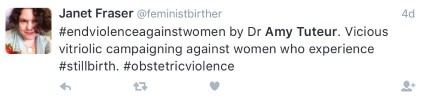
Janet Fraser, the Australian unassisted birth advocate who let her own baby die at homebirth has accused me of “obstetric violence.”

Fraser tweet 12-15

#endviolenceagainstwomen by Dr Amy Tuteur. Vicious vitriolic campaigning against women who experience #stillbirth #obstetric violence

You remember Janet, right? She’s the woman who, in the wake of her daughter’s entirely preventable death, declared:

[pullquote align=”right” color=”#fc0706″]There is such a thing as obstetric violence and it is perpetrated by homebirth advocates on babies.[/pullquote]

My birthrape with my first child is traumatic. My stillbirth was not.

As she went into the labor that eventually resulted in a dead baby, she actually gave an interview to an Australian newspaper on March 22,2009 in which she boasted of her decision:

Janet Fraser is in labour… Has she called the hospital to let them know what’s happening? “When you go on a skiing trip, do you call the hospital to say, ‘I’m coming down the mountain, can you set aside a spot for me in the emergency room?’ I don’t think so,” says Fraser, whose breathing sounds strained…

… She hasn’t seen a doctor or any health professional since becoming pregnant this time. No ultrasound, no genetic testing, no internal examinations, no stethoscope. Does she have any feeling for how long the labour will go? “I could do this for days. My daughter’s birth was 50-something hours. You just do it — it’s just birth, a normal physiological process.”

The baby was not born for another five days.

Fraser was excoriated by the coroner for her role in her baby’s death.

Essentially, Ms. Fraser was quite unprepared for what happened. There was not even a hard, flat surface available on which Roisin could be placed for resuscitation so these three amateurs – Ms. Fraser, Mr. Stokes and Ms. Duce, first placed the child on the rim of the inflatable pool and, when that proved unsatisfactory, used a chair. They were unable to abandon the chair and place Roisin on the floor in order effectively to administer CPR there because, the placenta not having been delivered, “that was as far as she would reach. ” Evidently, it occurred to nobody present to clamp and cut the cord and, anyway, Ms. Duce told the inquest, she had not been aware of the ready availability of any equipment to enable her to do so. According to Ms. Duce, further difficulties were encountered in administering CPR because Roisin was slippery and difhcult to hold and, evidently, it did not occur to anybody to wrap her in a towel although there were towels nearby.

And Fraser accuses me of obstetric violence?

There is such a thing as obstetric violence and it is perpetrated by homebirth advocates on babies.

Babies do not ask to be conceived. If a woman decides to conceive a baby and carry it to term, she has a moral obligation to care for the health and well being of that baby. She has a moral obligation to feed it and change it, and clothe it, and put it in a car seat when she takes the baby with her to the grocery store. She also has a moral obligation not to risk its life.

Obstetric violence toward babies involves real violence, injury and death, not hurt feelings. Over the years I have written about many women whose babies have died hideous deaths at homebirth.

These include breech babies whose heads were entrapped while their bodies dangled outside their mother’s vagina, and who died long before they could reach medical help.

They include babies who struggled for hours and suffocated, dropping dead into the hands of unsuspecting homebirth midwives who didn’t appropriately monitor their heart rates.

They include babies who slowly lost brain cells because their heads had delivered, but their shoulders became entrapped.

They include babies who died when they were suddenly extruded into their mother’s abdomen when a uterine incision ruptured and died for lack of oxygen long before they could reach a hospital.

They include babies who survived but suffered serious brain injuries leading to lifelong disabilities affecting their ability to move, to reason, to live on their own, to fulfill the potential that they had when labor started.

And, of course, they include babies like Roisin, whose mother’s hideous narcissism led to her death.

Who cares about the obstetric violence perpetrated on these babies?

Certainly not Janet Fraser who thinks everything is about her.

Certainly not homebirth midwives, who never met a risk they couldn’t label as a variation of normal.

Certainly not homebirth advocates, who never heard of a homebirth death that they couldn’t rationalize with the all purpose, and incredibly ugly claim that “some babies are just meant to die.”

As far as I’m concerned, there’s something very wrong when women claim that hurting their feelings is “violence. There is something very wrong when letting a baby suffocate to death, half the body born, and half still inside the mother is dismissed as inevitable, especially when it was not. And there is something very wrong when the obstetrician cares more about whether your baby lives or dies than you do.

As the Coroner noted at the inquest into Roisin Fraser’s death:

[Her views] are wrong views, extravagantly expressed and quite insensitive to the harm they may do to others, whether inexperienced mothers or children like Roisin whose chance of life was so unnecessarily put at risk. lf they seem intellectually valid or politically attractive to Ms. Fraser, she might give thought or more thought to the effect they may well have on children like Roisin.

Stop obstetric violence toward babies. Narcissism kills, as Janet Fraser continues to demonstrate.

Riddle: how many homebirth advocates does it take to change a light bulb?

image

Ten:

One to teach the course “Empower yourself by changing your own light bulb.”

One to whisper affirmations encouraging the light bulb to be in the correct position.

One to photograph the event.

One to tweet the event live.

One to fill the plastic kiddie pool. (Note: professional electricians claim that standing in water while changing a light bulb is dangerous, but they just say that to ruin your light bulb changing experience.)

One to call 911 if you get electrocuted while standing in water while changing the light bulb.

One to reassure you that people get electrocuted changing light bulbs even when they are not standing in water, so you shouldn’t let the warnings of those stupid electricians scare you.

One to help you eat while changing the light bulb in order to keep up your strength.

One to tell you to turn the bulb only when you get the urge.

And finally, one to actually change the light bulb and pretend to have an orgasm while doing it.


This piece first appeared in April 2010.

Nicola’s noxious narcissism: when the birth is more important than the baby

image

Which came first, the narcissism or the birth?

Damned if I know.

Regardless, something is very, very wrong when the birth is more important than the baby.

[pullquote align=”right” cite=”” link=”” color=”” class=”” size=””]We rolled the dice thinking it wouldn’t happen to us and we lost.[/pullquote]

Take Nicola for example.

After being “disrespected” during her first birth:

For my second pregnancy I chose to sit outside the system and hired independent midwives. I chose to birth at home against consultant advice as I didn’t trust them to look after my best interests. I put in a lot of work and effort to prepare myself for a natural birth which payed off as I had a wonderful birth.

Her work and effort paid off in a “wonderful” birth.

The birth was not wonderful for the baby, though.

image

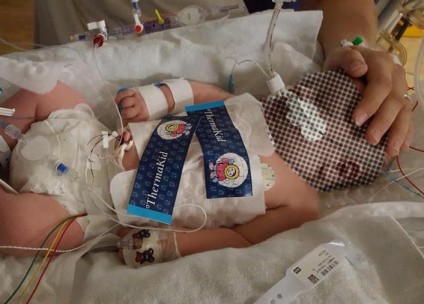
But i was very unlucky, my baby was born not breathing 40 minutes away from hospital from which he has sustained serious brain injury and will live with serious life long disabilities.

Now I will spend the rest of my life wondering whether I should have gone against every instinct in my body and done as I was told by people I didn’t trust. If I had done that would my son have arrived safely??

Unlucky? Does Nicola blame herself for her son’s brain damage? Be serious!

…And it is likely he would have had a better outcome if he’d been born in the hospital, if I’d been hooked up to cfm. What a shame that my trust had been completely abused and destroyed first time round.”

And:

Birth is inherently risky. We rolled the dice thinking it wouldn’t happen to us and we lost.

Let me fix that for you Nicola. YOU rolled the dice with HIS life and HE lost.

It’s not a shame; it’s a tragedy that Nicola thought whether or not she was “disrespected” was more important than whether or not her son survived birth intact.

When exactly did the birth become more important than the baby?

Maybe Chrissy could tell us.

Here’s what she posted to her Facebook VBAC group:

image

I GOT MY VBAC!!!!! I want to share my vbac birth story with everyone.

What about the baby? You remember the baby, right? Ostensibly the entire purpose of the pregnancy?

Her was born at 28 weeks with intrauterine growth restriction, is intubated, in the NICU and potentially may not survive, but Chrissy knows what’s important to her. She GOT HER VBAC!!!!!

Carmina, on the other hand, seems stunned by what happened at her homebirth. According to the GoFundMe page:

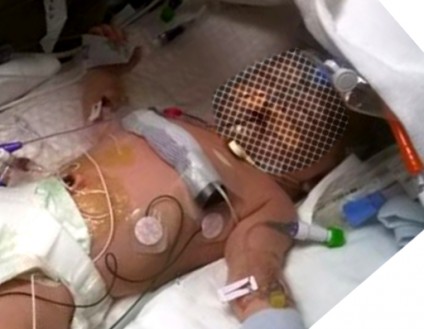
T. was born on Wednesday, December 2, 2015 at home by mid wife. At some point during his birth two things went drastically wrong. He inhaled meconium which filled his lungs and the umbilical cord wrapped around his neck, cutting off his oxygen.

The midwife was able to rescusitate him after approximately 13 minutes, however, it is unknown how long T. had been cut off from oxygen intake, or at which point he inhaled the meconium. For the first 40 minutes of his life, he was not in Doctors’ hands as he was in route via helicopter to the Hospital.

image

According to his mother:

He was born at home, naturally with our amazing midwife … My water broke when his head came out and meconium spilled out … His umbilical cord was wrapped around his neck and I pushed his body out we could see he was blue and not breathing.

Our midwife immediately unwrapped the cord and started CPR. We called 911 and the ambulance got there in about 15-20 minutes … By the time I got to the hospital in an ambulance right behind him, they had him completely surrounded with a team of 8-10 …

The baby was transferred to another hospital:

Our plan was to wait until the next day … But then we received a phone called from the doctor that sounded very grim … We went to see T. and the doctor gave an update of how they cleaned him out as best they could and they were worried he had severe brain damage.

He underwent brain cooling therapy and at this point his prognosis was unknown.

It didn’t have to happen this way. Had his mother been more concerned about his safety than her experience, he’d be fine and she’d probably be complaining about her “unnecessary” C-section.

When did the birth experience become more important than the baby?

Maybe one of these women could explain it to us. Inquiring minds want to know.

Sancti-selfies: the latest weapon in the mommy wars

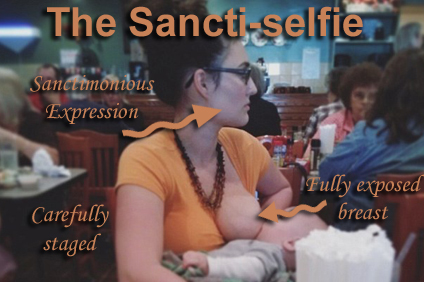
Sanctiselfie

They say a picture is worth a thousand words. That’s why sancti-selfies have become the latest weapon in the mommy wars.

Several weeks ago I wrote about brelfies, breastfeeding selfies. I quoted the paper Selfies| Virtual Lactivism: Breastfeeding Selfies and the Performance of Motherhood by Boon and Pentney.

[pullquote align=”right” color=”#c78157″]The sancti-selfie says: I am a better mother than you![/pullquote]

Situated between lactivism and narcissism, the breastfeeding selfie must … be understood as both a personal gesture and a political act…

Like other selfies, breastfeeding selfies offer individuals the possibility of microcelebrity, the opportunity to present carefully manufactured and managed online selves across a range of social media platforms, with the “audience” imagined as fans…

If … participation in social media is modeled on corporate branding strategies, particularly active self-promotion and status-seeking behavior, then the selfie may be the most obvious example of the self as brand commodity.

Brelfies are a subset of what I call “sancti-selfies.”

What are sancti-selfies?

Situated between sanctimony and narcissism, the sancti-selfie is both a personal gesture and a political act. It conveys a dual message:

Look at me! I’m an awesome mother!

and:

If you aren’t mirroring my own choices back to me, I am a better mother than you.

In other words, they’re just the latest sanctimommy tool for compelling ideological adherence.

In my experience, most sancti-selfies are posted by breastfeeding and homebirth advocates. The sancti-selfie above, taken by Ashley Kaidel, is a perfect example.

Carefully staged tableau? Check!

Breast exposed far more than needed to feed a baby? Check!

Sanctimonious expression? Check!

Many, many women breastfeed. Very few feel compelled to photograph themselves doing so and even fewer feel the need to post those photos on social media.  But among lactivists and homebirth advocates, sancti-selfies are practically de rigeur.

Think about it. How many women post photos of themselves feeding their infants on social media? Very few and nearly all of them are breastfeeders. How many women feel compelled to post photos and videos of a baby emerging from their vagina. Very few and nearly all are homebirth advocates. A baby born vaginally in a hospital emerges in exactly the same way, yet women who have epidurals don’t feel the need to display it on Twitter.

That’s why, as Boon and Pentney note, brelfies are posted almost exclusively privileged women:

Perhaps not surprisingly, then, the vast majority of breastfeeding selfies posted … feature white mothers and children and reference cisgender, heterosexual family structures. While most images do not include the full body, the bodies that are shown appear to align with standard body ideals; for example, there are no visibly fat bodies included.

What’s that I hear you say? They’re normalizing breastfeeding and vaginal birth?

Are we really supposed to be gullible enough to believe that?

When lactivists promote normalizing breastfeeding they are using “normal” to signify normative and morally preferable. When homebirth advocates display babies dangling from vaginas they are using “normal” to signify that unmedicated vaginal birth is normative and morally preferable.

Birth and breastfeeding advocates are aware that describing breastfeeding and childbirth in these ways is vicious, creating two classes of mothers, good mothers and bad mothers. That’s the point point of sancti-selfies, to be sanctimonious.

They want to behave viciously but they don’t want to be accused of doing so. They claim they are “normalizing” breastfeeding and vaginal birth in order to create plausible deniability.  No, no, no, they’re not trying to shame formula feeding mothers, they’re simply pointing out that breastfeeding is the normal and natural way to feed an infant. No, no, no, they don’t mean that normal birth is better; they just mean that it is the common way to give birth.

We should recognize sancti-selfies for what they are: portraits of the ugly marriage of narcissism and sanctimony that characterizes so much of lactivism and homebirth (as well as natural childbirth) advocacy.

And we shouldn’t let them get away with it.

Don’t wait! Start your career in quackery today!

image

Hi, folks! Ima Frawde here!

Congratulations on your decision to embark on a career in quackery! It’s perfect for you! No education required, no investment required, no intelligence required. All you need is the cunning to realize that there is a boatload of money to be made by promoting pseudoscience to gullible lay people.

There are only three things you need to do to launch your career. Get a free website, fill it with nonsensical content, and register for a Paypal account; then watch the money flow in. But wait! Ima Frawde, connoisseur of quackery, has created a step by step guide to content for your website. Just follow these simple steps and you’re ready to go.

Step 1: Inspire fear, because, fear of the unknown is at the heart of all quackery.

We are surrounded by visible and invisible toxins that cause cancer, autism, ADD/ADHD and chronic fatigue syndrome. There are toxins belched into the atmosphere by greedy corporate moguls, toxins in vaccines, even toxins produced by own bodies. That’s why everyone needs to vigilant in refusing anything that isn’t 100% natural, and to constantly detoxify using preparations/supplements/guidebooks you can buy on this website.

Step 2: Invoke a conspiracy.

Any product that is not 100% natural is part of a huge global conspiracy by doctors, Big Pharma, Big Business, or doctors colluding with Big Pharma and Big Business. Every medication is unnecessary, ineffective and TOXIC! With the information on this website, you won’t be manipulated and fooled by these giant conspiracies. The knowledge you glean here will set you free.

Step 3: Flatter the reader.

Why do those people with fancy pants degrees think they know more than you? Sure you never attended college, maybe even dropped out of high school, but we both know that with your incredible native intelligence and the education you get at this website, you’re far more educated much than those stupid doctors, scientists and public health officials.

Step 4: Explain that intuition is far more important than knowledge.

Don’t forget! Your incredible native intelligence is supplemented by your extraordinary intuition. If you feel that a toxin is making you sick, then that’s what’s making you sick. If you feel that my herbal preparations/supplements/guidebooks are making you well, then they are making you well. Pay no attention to your extraordinary weight loss and the pleas of your oncologist. There’s no need for chemotherapy when you have my preparations/supplements/guidebooks!

Step 5: Insist that no one knows more about a disease in his or her body than the person him or herself.

No one knows more about preventing, diagnosing, and treating any disease in your body than YOU do.

Step 6: Aver that you have no other motivation than to share your knowledge with the uninformed.

I’ve learned the secrets to avoiding any and all diseases, and it’s not just proper diet. My herbal preparations/supplements/guidebooks will help you avoid all diseases, too.

Step 7: Explain that Big Pharma and Big Business don’t want anyone to know the information you are about to disclose.

Cancer, autism, ADD/ADHD and chronic fatigue syndrome can be prevented or cured, but Big Pharma and Big Business don’t want you to know what I’m about to share with you. It’s in their interest to pretend that vaccines prevent disease. But if you send $14.95 (plus S&H), I’ll send you a guidebook that will explain that vaccines CAUSE disease. It’s in their interest to pretend that an expensive chemotherapeutic agent is the best treatment for cancer when the truth is that for only $24.95 (plus S&H) my preparations/supplements/guidebooks will cure you faster, with fewer side effects for lower cost.

Step 8: The big finish.

My preparations/supplements/guidebooks can both prevent disease AND cure it! The environment may be filled with toxins spewed by Big Business, but you’re protected. Your body is constantly producing toxins, but I’ll show you how to get rid of them. Big Pharma is hiding the cures for all diseases, but with my preparations/supplements/guidebooks you will outwit their evil efforts.

It doesn’t matter that you have no education in science or statistics; I don’t either. Education is totally over-rated. With my preparations/supplements/guidebooks, you’ll learn something better — how to access your intuition. No one knows your body better than you. No one knows better what it needs to stay healthy and what it needs to recover from illness.

Just send your money today and I’ll send you the secrets of my financial health. Defy the evil medical establishment, thumb your nose at Big Business, learn the information they are hiding from you and cure yourself. At only $24.95 (plus S&H), it’s a steal at twice the price.


This piece first appeared in October 2011.

World Health Organization’s optimal C-section rate officially debunked

WHO debunked

I’ve been writing for years that the World Health Organization conjured its “optimal” C-section rate of 10-15% from thin air. It is the childbirth lie that would not die. Now researchers from Harvard and Stanford have put a stake through its heart in the just published paper Relationship Between Cesarean Delivery Rate and Maternal and Neonatal Mortality.

More than 7 years ago I wrote:

[pullquote align=”right” color=”#4f933d”]There appears to be NO increased risk of either maternal or neonatal mortality for C-section rates as high as 55%.[/pullquote]

Anti-cesarean activists love to point out that the World Health Organization has recommended that the C-section rate should be 10-15%. Unfortunately, the WHO appears to have pulled those numbers out of thin air. Its own data shows that a 15% C-section rate does not result in the lowest possible levels of either neonatal mortality or maternal mortality…

At the time I compared international C-section rates with maternal and neonatal mortality rates and found:

The only countries with low rates of maternal and neonatal mortality have HIGH C-section rates … The average C-section rate for countries with low maternal and neonatal mortality is 22%, although rates as high as 36% are consistent with low rates of maternal and neonatal mortality.

Researchers from Harvard and Stanford just got around to performing the same calculations and this is what they found:

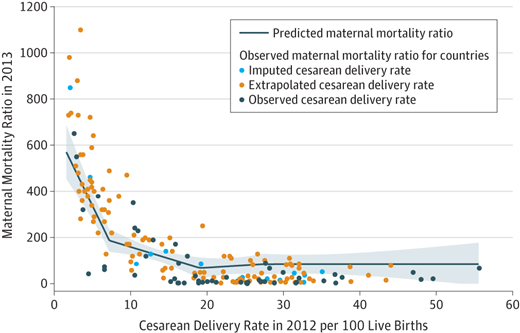
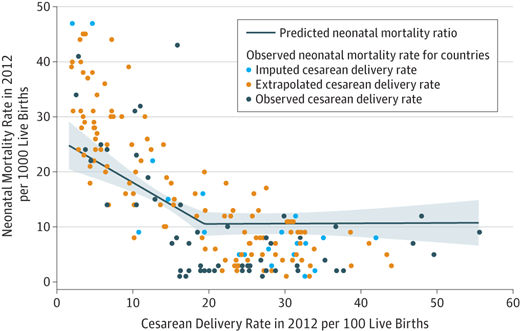
The optimal cesarean delivery rate in relation to maternal and neonatal mortality was approximately 19 cesarean deliveries per 100 live births.

In other words, they found almost exactly the same thing I found 7 years ago.

The graphs they created are quite impressive:

Cesarean vs. maternal mortality

Cesarean vs. neonatal mortality

These graphs show that C-section rate below 19% lead to preventable maternal and neonatal deaths. In other words, they show that the WHO “optimal” rate, far from being optimal, is actually deadly.

They also show that C-section rates above 19% are NOT harmful. There appears to be NO increased risk of either maternal or neonatal mortality for rates as high as 55%.

According to the press release that accompanied the paper:

“On a nationwide level, our findings suggests there are many countries where not enough C-sections are being performed, meaning there is inadequate access to safe and timely emergency obstetrical care, and conversely, there are many countries where more C-sections are likely being performed than yield health benefits,” said Dr. Alex Haynes, primary investigator of the study, a surgeon and associate director of Ariadne Labs’ Safe Surgery Program. “This suggests on a policy level that benchmarks for C-section rates on country-wide level should be reexamined and could be higher than previously thought.”

But old prejudices die hard and journalists are already spinning the paper as an indictment of the US C-section rate. The Boston Globe insists Sky-high C-section rates in the US don’t translate to better birth outcomes. But they don’t translate to worse outcomes, either. Moreover, death is not the only outcome of concern. Many C-sections are done to prevent neonatal brain damage and to date there have been no international studies comparing C-section rates and rates of brain injury.

So it is entirely possible, indeed it is likely, that the optimal C-section rate is higher than 19%.

There are two main take home messages from the study.

The first is that C-section rates of less than 15% are UNSAFE. The WHO simply made up their optimal rate and basically ignored the scientific evidence. If I could figure out an optimal rate with some back of the napkin calculations 7 years ago, they could have figured it out, too. Their optimal rate reflected their personal prejudices, NOT science.

The second take home message has been obscured in the mindless demonization of C-sections that has been promoted by the natural childbirth industry: there is NO EVIDENCE of harm to mothers or babies from C-section rates as high as 55%.

The unreasoning prejudice against C-sections has got to stop. It’s not good for babies; it’s not good for mothers; and it’s not good for science.

This paper is a tiny first step.

Dr. Amy